You tapped a friend's profile and a tiny planet was sitting there. Mercury. Neptune. Something.
And Snapchat, being Snapchat, explained absolutely nothing.
So you're left guessing. Is being someone's Neptune an insult? Why did your planet suddenly change overnight? And where do you even find yours?
This guide clears all of it up. We'll cover the full planet order, what each one actually means, the colors, how to check your spot, and the stuff Snapchat conveniently forgets to mention.
Let's get into it.
What Are Snapchat Planets?
Snapchat Planets are a visual way of ranking your closest friends. They come with the Snapchat+ subscription, and Snapchat calls the whole thing the Friend Solar System.
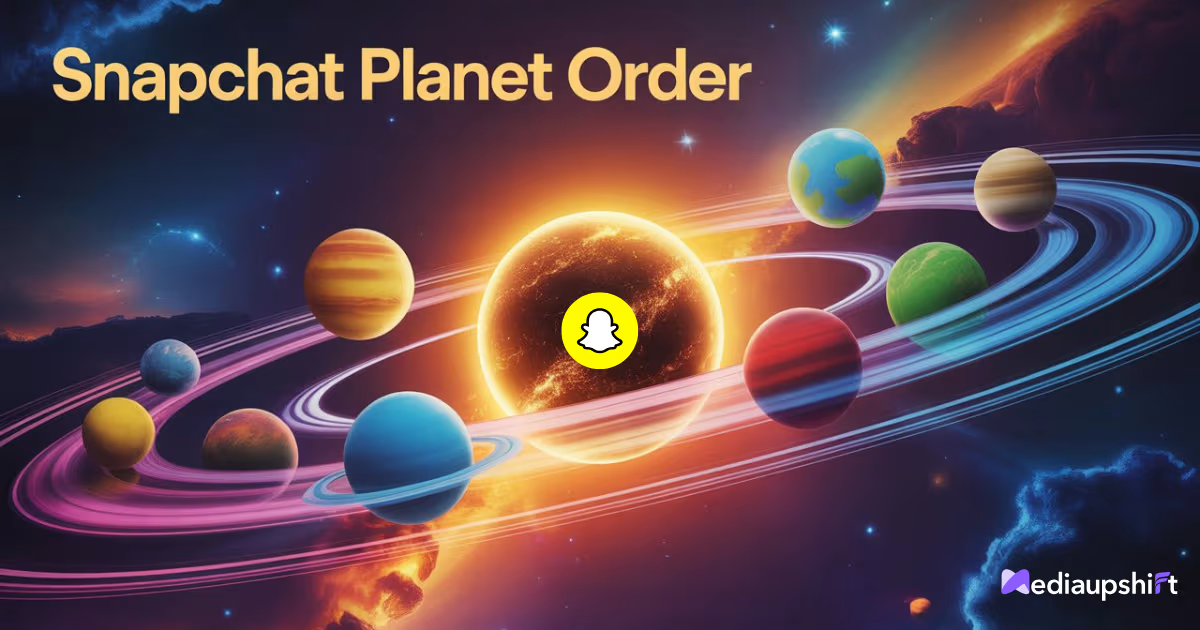
Here's the idea. You're the Sun. Your eight closest friends orbit you as planets.
The friend you talk to most sits closest as Mercury. The one you interact with least in that top eight lands out on Neptune.
It's basically your old "best friends" list, dressed up as a galaxy. Instead of a boring row of names, you get a mini solar system that shifts as your friendships change.
And no, you don't pick who goes where. Snapchat's algorithm decides based on how you actually use the app.
How the Snapchat Friend Solar System Works
The whole thing runs on interaction. The more you snap and chat with someone, the closer their planet moves to you.
Snapchat watches a few signals in the background:
- How often you snap each other
- How much you chat back and forth
- Whether you reply to their stories
- Voice and video calls
Notice the theme? It's all two-way. Sending 40 snaps to someone who never replies won't rocket them to Mercury.
Reciprocity matters. Consistent, mutual conversation is what pulls a planet inward.
And because it's always comparing your friends against each other, positions move on their own. A friend can slide from Venus to Saturn without you doing anything "wrong." Someone else just got more active.
That's the part that trips people up. Your planets aren't a fixed scoreboard. They're a live ranking.
The Snapchat Planet Order (Mercury to Neptune)
The order copies our real solar system exactly. Closest to the Sun equals closest friend.
Here's the quick version before we break each one down:
| Position | Planet | What it means |
|---|---|---|
| 1st | Mercury | Your #1 best friend |
| 2nd | Venus | Second closest |
| 3rd | Earth | Strong, steady friend |
| 4th | Mars | Regular contact |
| 5th | Jupiter | Frequent but not daily |
| 6th | Saturn | Talk sometimes |
| 7th | Uranus | Low interaction |
| 8th | Neptune | Edge of your top 8 |
Simple enough. Now let's look at what each planet looks like and means, because the colors matter too.
What Each Snapchat Planet Means (With Colors)
Every planet has its own look — a color, hearts, stars, sometimes a ring. If you know the visuals, you can read your rank in a glance.
Mercury: Your 1st Best Friend
Mercury is your ride-or-die.
It shows up as a reddish orange-brown planet with five red hearts floating around your friend's Bitmoji. This is the person you snap and chat with more than anyone.
If you're someone's Mercury, you two are basically inseparable on the app.
Venus: Your 2nd Best Friend
Venus is a tan or light-brown planet ringed with pink, yellow, and blue hearts.
This friend is right behind Mercury. Still super close, just edged out by one person.
Fair warning: Mercury and Venus swap constantly. A busy few days can flip them.
Earth: Your 3rd Best Friend
Earth is the easiest one to spot. It looks like the real Earth — blue and green — with a little Moon, red hearts, and yellow stars.
This is a solid, steady friend. Not your #1, but reliably in your circle.
Mars: Your 4th Best Friend
Mars is a red planet with blue and purple hearts and a few stars.
People call it "the red planet on Snapchat," and it gets confused with Mercury a lot. The difference? Mars leans red-orange with purple hearts. Mercury sticks to red hearts only.
Being someone's Mars means you talk regularly, but three friends currently edge you out.
Jupiter: Your 5th Best Friend
Jupiter is a large orange-brown planet with swirling stripes, just like the real thing.
This friend is in your rotation, but the chats aren't daily. Think steady streaks and story replies more than long conversations.
Quick tell: from Jupiter outward, the hearts start disappearing. Mercury through Mars are heart-heavy. The further out you go, the plainer the planet. Easy way to eyeball a rank.
Saturn: Your 6th Best Friend
Saturn is the one with the ring. Orange planet, signature ring, a few stars.
You know this person and you talk, just not that often. A small dip in activity can push them further out fast.
Uranus: Your 7th Best Friend
Uranus is a green planet, usually with no hearts at all.
This spot is shaky. Friends here rotate in and out of your top eight all the time based on tiny changes in activity.
Wondering "what's the green planet on Snapchat?" — this is your answer.
Neptune: Your 8th Best Friend
Neptune is a blue planet with minimal decoration.
It's the outer edge of your top eight. Still a friend, still counts. But this is usually the first planet to disappear when you go quiet with someone.
Best Friends Badge vs Friends Badge
This is where people get confused, so let's kill the confusion.
When you open a profile, you'll see one of two badges with a gold ring. They mean very different things.
Best Friends badge means it's mutual. You're both in each other's top eight. The connection goes both ways.
Friends badge means it's one-sided. You're in their top eight, but they didn't make yours — or the feature isn't switched on for them.
Here's the important part: your planet rankings are private. A friend can be your Neptune while you're their Mercury, and neither of you sees the other's list.
So a Friends badge isn't a snub. It just means the activity is uneven right now.
How to See Your Snapchat Planet
Checking your spot takes about ten seconds. You just need Snapchat+ active.
Here's how:
- Open Snapchat and go to your friend's profile.
- Tap their Bitmoji or open the chat.
- Look for the gold Best Friends or Friends badge near their name.
- Tap or press the badge.
- Watch the animation — your Bitmoji appears on your planet.
Repeat it with different friends to map out your full ranking.
No badge showing up? That usually means you're not in their top eight, or one of you doesn't have the feature enabled.
How to Enable (or Disable) the Friend Solar System
Big thing most guides skip: the Solar System is off by default for new Snapchat+ users now.
Snapchat turned it off after feedback that the rankings were stressing people out, younger users especially. So if you just subscribed and there are no planets anywhere, that's your answer.
Here's how to switch it on:
- Open Snapchat and tap your profile icon (top left).
- Scroll to the Snapchat+ section.
- Find the Friend Solar System toggle.
- Turn it on and confirm.
Want it gone? Same path, just flip the toggle off. Disabling it only hides the planets — it doesn't change your friendships or reset any rankings.
Why Your Snapchat Planets Disappeared
You checked yesterday, the planet was there, and now it's gone. Don't panic. This is almost always normal, and it's rarely about you.
A few common reasons:
Your ranking shifted. If your activity with that friend dropped, they may have slipped out of your top eight. Someone else took the spot.
The feature got toggled off. Either you or the app disabled the Solar System.
Your subscription lapsed. No active Snapchat+ means no planets.
The app just needs a refresh. Rankings update in the background and can lag. Close the app or clear the cache.
A missing planet doesn't mean you were blocked or removed. Most of the time it's a quiet ranking adjustment from the last day's activity.
How to Move Up in Someone's Solar System
Want to become someone's Mercury? You can't force it, but you can absolutely nudge it.
The trick is genuine, steady interaction, not spam.
Keep it consistent. A little every day beats 50 snaps in one burst then silence for a week. The algorithm rewards steadiness.
Go one-on-one. Direct snaps and chats carry more weight than group snaps for individual rankings.
Make it two-way. Reply to their stories. Actually chat back. Mutual beats one-sided every time.
Hold your streaks. Streaks signal ongoing contact and help you stay visible.
Respond quickly. Leaving snaps on read for days? The app notices the drop-off.
None of this is a hack. It's just paying attention to the friendship — which is kind of the whole point.
Snapchat Planets vs Snap Score vs Streaks vs BSF Emojis
Snapchat has a bunch of friendship signals, and they get mixed up constantly. Here's the difference in plain terms.
Planets rank your top eight friends by relative closeness. Snapchat+ only.
Snap Score is a running total of snaps you've sent and received across your whole account. It's a number, not a ranking.
Streaks track how many days in a row you and a friend have snapped each other. That's the fire emoji.
BSF (Best Snap Friends) emojis are the little icons — yellow heart, red heart, smile — next to names. Those are free for everyone and predate planets.
Quick way to remember it: BSF emojis are the free version. Planets are the detailed, paid, visual upgrade.
Are Snapchat Planets Safe for Teens?
Worth a straight answer, since parents ask.
Snapchat's minimum age is 13, and the planet system is built to be light and fun. But ranking friendships can create pressure. Nobody loves finding out they're a Neptune.
That's actually why Snapchat made the feature optional and off by default. A few things worth knowing:
- Rankings are completely private. No one sees where they sit in your system.
- The algorithm only tracks interaction frequency, not message content or photos.
- It can be turned off in two taps.
The healthy framing: your position is app activity, not a measure of who matters in real life. Worth a quick conversation with younger users so they don't read too much into it.
What's New with Snapchat Planets in 2026
Snapchat kept tweaking the feature this year. A few updates worth flagging:
Smoother animations. The planet reveal got a visual refresh with cleaner transitions.
New Bitmoji reactions. There are more animated reactions baked into the Solar System now.
Galaxy Badges (testing). Snapchat is trialing a reward for people who interact consistently with their closest friends. If it rolls out fully, expect the Solar System to get a bit more interactive.
None of these change the core order — Mercury to Neptune still rules. But the feature is clearly getting more attention, not less.
The "9th Planet" Rumor: Is There a Secret Planet?
Every so often someone swears there's a hidden ninth planet on Snapchat.
There isn't. The Friend Solar System caps at eight, matching the eight planets in our real solar system. No secret Pluto, no bonus tier.
If you spot "extra" planets in screenshots online, it's almost always edited or fake. Eight friends, eight planets. That's the whole system.
Planets for Creators and Brands
The Solar System isn't just a fun toy — it's a signal.
For creators, it hints at who your most engaged followers are. The people snapping you back daily are the ones building real loyalty, and that's gold for community-driven content.
Brands can lean into the theme too. Playful solar-system content lands well with Gen Z, and understanding engagement patterns helps you grow your social media presence with the right audience.
The takeaway: interaction data is worth paying attention to. It tells you who's actually listening.
Frequently Asked Questions
What do the planets mean on Snapchat?
They rank your eight closest friends. The closer a planet is to you (the Sun), the more you interact with that person. Mercury is your #1, Neptune is your #8.
What is the order of Snapchat planets?
Mercury, Venus, Earth, Mars, Jupiter, Saturn, Uranus, Neptune. That's closest friend to least close, same as the real solar system.
What does the red planet mean on Snapchat?
That's usually Mars, your 4th closest friend — a red-orange planet with purple and blue hearts. Don't confuse it with Mercury, which has only red hearts.
What's the green planet on Snapchat?
Green is Uranus, your 7th closest friend. It typically shows up with no hearts around it.
What does the blue planet mean on Snapchat?
Blue is Neptune, your 8th and final best friend. It's the outer edge of your top eight.
Do I need Snapchat+ to see planets?
Yes. The Friend Solar System is a Snapchat+ feature only. Free accounts can't see it, even if they have a best friends list.
Snapchat+ starts around $3.99/month in the US, with cheaper yearly plans available.
Can my friends see where they rank in my solar system?
No. Your rankings are private. They can only see their own planet in their own system — never yours.
How often do Snapchat planets update?
Regularly, based on recent activity. Positions can shift daily as your interactions with different friends go up or down.
Why can't I see any planets even with Snapchat+?
The feature is off by default for new subscribers. Turn it on under Profile → Snapchat+ → Friend Solar System toggle.
Can I choose my own planet?
No. The algorithm assigns everything based on how you use the app. There's no manual override.
How do I make someone my #1 best friend fast?
Snap and chat with them consistently, one-on-one, for around two weeks. Steady mutual interaction is what pushes them to Mercury.
Is there a way to see planets without Snapchat+?
Not officially. Any site or app claiming to show your planets for free without a subscription isn't legit — skip it.
Does blocking or removing a friend affect planets?
Yes. If you block or unfriend someone, they drop out of your Solar System entirely.
Final Thoughts
Snapchat Planets look confusing at first, but the logic is simple once it clicks.
You're the Sun. Your eight closest friends orbit you, ranked by how much you actually talk. Mercury's your closest, Neptune's the edge, and everything moves based on real interaction.
It's a small feature with a surprising pull. Part friendship tracker, part gentle nudge to stay in touch. Just remember it measures app activity, not real-life importance.
Now go check who your Mercury is. You already know, don't you?